Mind Mapping
Organise your thoughts, connect ideas, and unlock your creativity. Mind mapping helps you learn better, remember more, and think clearly.

Traditional notes
- — Linear
- — Hard to connect
- — Easy to forget
Mind map
- — Visual
- — Connected
- — Easy to remember

Say one word, and your brain does this on its own:
- Apple
- Fruit
- Tree
- Nature
- Health
A mind map simply writes that chain down. That is the whole idea.
Today's journey
- ①Understand
- ②Watch
- ③Build
- ④Reflect
- ⑤Go Further
Professional software — turn your map visual
Ready to go digital? Open any official app and start building.
Great mind maps come from clear thinking — not expensive software.
These applications are listed for educational purposes only. This page is not affiliated with, endorsed by, or sponsored by any of them. All product names and trademarks are the property of their respective owners.
Step 1 of 5 · ≈ 5 minutes
Understand
A mind map is a visual diagram that arranges ideas around one central subject, letting them branch outward instead of running top to bottom.
- Do you forget what you study?
- Do your notes become messy?
- Do you struggle to organise ideas?
- Do you want to understand yourself better?
Then mind mapping helps you:
Did you know?
Tony Buzan popularised modern mind mapping in the 1970s as a way of reflecting how the brain naturally connects ideas — though the idea of drawing knowledge as branches goes back centuries.
Quick check
Where should a mind map begin?
Key takeaway
A mind map is not about drawing. It is about organising thinking.
Step 2 of 5 · ≈ 6 minutes
Watch one being built
Four stages, from a blank page to a finished map. Each stage teaches one rule.
Stage 1 — The centre
Why? Because every branch needs something to hang from. Without a centre you are writing a list.
One word in the middle of the page: ME. That is the whole stage. It looks like nothing, and it decides everything that follows.
Try it yourself: take a blank page and write ME in the middle. Leave space all around it.
A map is never finished. Add to it as you notice things — that is the whole point of keeping it.
Did you know?
Your brain processes an image far faster than a sentence. This is why a keyword beside a small doodle is remembered long after a paragraph is forgotten.
Quick check
Which is better on a branch?
Key takeaway
Every good map starts messy. Structure is something you find, not something you plan.
Step 3 of 5 · ≈ 8 minutes
Build yours
Four questions to sit with. Answer them as keywords — the same rules you just watched.
Your answers save automatically in this browser.
Discover your strengths
Don't think about skills first. Think about moments.
Ask yourself
- When do people ask for my help?
- What makes me lose track of time?
- What achievement makes me proud?
- What do I enjoy learning?
Now write 3–5 strengths.
Stuck? Words you could borrow: Good listener · Helpful · Curious · Creative · Honest
Nothing here yet.
Name your weak spots
Don't list faults. Think about situations — a weakness is usually a pattern, not a defect.
Ask yourself
- What do I put off until the last minute?
- Which situations drain me?
- When did I last say yes when I meant no?
- What would a close friend gently tell me?
Now write 2–4 honestly.
Stuck? Words you could borrow: Procrastination · Shy speaking · Says yes too fast · Impatient
Nothing here yet.
Find your values
Don't write what sounds good. Look at decisions you have already made.
Ask yourself
- Where does my time actually go?
- Where does my money actually go?
- What would I refuse to do, even for a reward?
- Who do I admire, and why?
Now write 3–5 — keep it short.
Stuck? Words you could borrow: Respect · Family · Integrity · Learning · Freedom
Nothing here yet.
Set your goals
Don't start with five years. Start with this semester and work outward.
Ask yourself
- What do I want by the end of this semester?
- What about this year?
- Where do I want to be in five years?
- How would I know I had got there?
Now write 2–4. Make each one specific.
Stuck? Words you could borrow: Graduate · Improve English · Start a business · Get fit
Nothing here yet.
Key takeaway
The map you just built is data about you that did not exist an hour ago.
Step 4 of 5 · ≈ 6 minutes
Reflect
One to three sentences each. Short answers get finished.
Turn insight into action
GROW is not another form to fill in. It is the conversation a coach would have with you about the goals you just wrote down — four questions, in order.
Key takeaway
A goal without a first action is still just a wish.
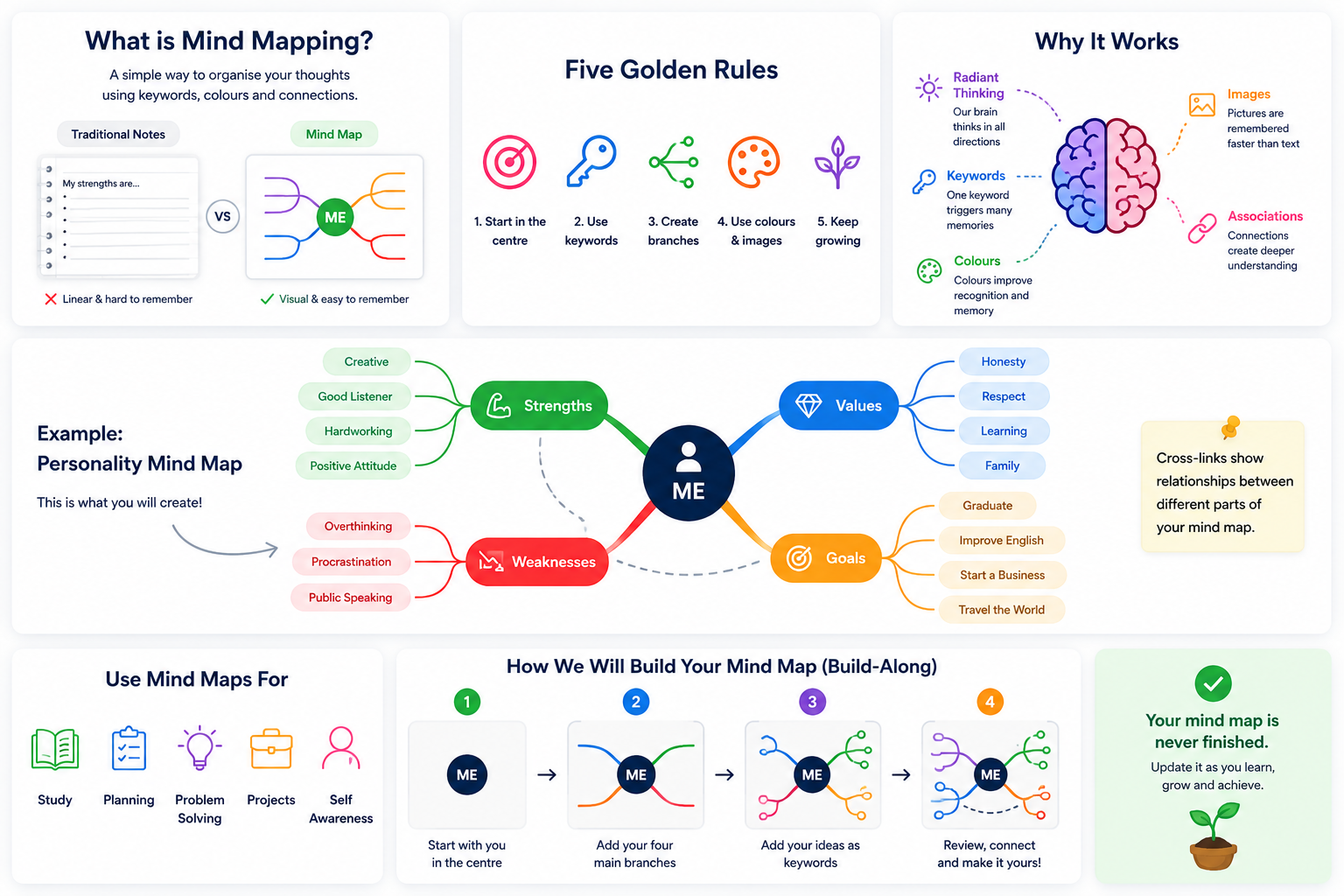
The whole lesson on one page
Print this, or keep it on your phone. Everything you have just done, in one picture.
Before you leave
Can you now…
- Explain what mind mapping is?
- Build a mind map?
- Identify your strengths?
- Identify your values?
- Plan your goals?
- Create a visual version?
Your challenge
Congratulations — you've created the content for your first personality mind map.
- 1Open Canva or XMind.
- 2Turn your ideas into a colourful visual map.
- 3Print it.
- 4Keep it where you'll see it.
- 5Return after one month and update it.
Watch yourself grow.
Step 5 of 5 · browse at your own pace
Go further
Open only what you need. Nothing below is required to finish the lesson.